CMS Hospital Quality Reporting FHIR Implementation Guide
0.1.0 - ci-build

CMS Hospital Quality Reporting FHIR Implementation Guide
0.1.0 - ci-build
CMS Hospital Quality Reporting FHIR Implementation Guide - Local Development build (v0.1.0) built by the FHIR (HL7® FHIR® Standard) Build Tools. See the Directory of published versions
This guide profiles two data-exchange patterns for the facility-to-HQR submission direction: push submission with results retrieval, and invited-pull. Push submission is the committed, live-tested pattern for this guide and the Connectathon; invited-pull is presented as a concept for discussion. The diagram below depicts both, end to end.
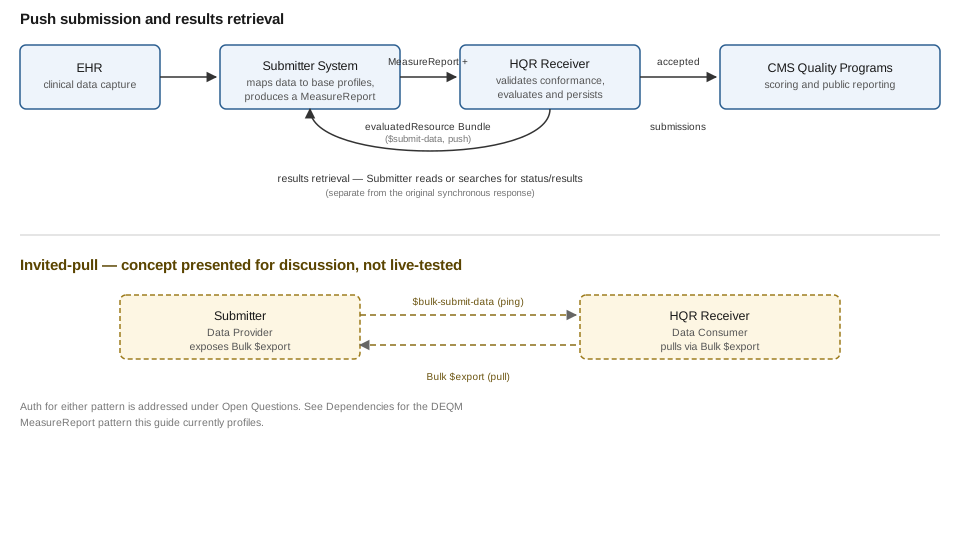
HQRSubmissionMeasureReport is built on the Data Exchange MeasureReport pattern (DEQM US Realm
STU5 in version 0.1.0 — see Dependencies for this guide's version 1.0.0
target), which carries raw data-of-interest rather than a pre-calculated result. Whether the
Submitter also runs CQL and includes a calculated result, or sends raw data only, is addressed in
Open Questions; step 4 below reflects the Data-Exchange-native behavior
(receiver calculates) as the current design assumption, not a settled decision.
MeasureReport
(HQRSubmissionMeasureReport in this guide) carrying raw data-of-interest, packaged together
with the resources it references (via evaluatedResource) in one submission Bundle — see
Dependencies for the precise shape and why this is one Bundle per patient,
not an aggregate. The profile itself is measure-independent — this vertical slice
exercises it against three either/or test measures, with no primary/stretch tiering: CMS71
(STK-3), CMS506, and EXMConnectathonSept2026Simple
(https://madie.cms.gov/Measure/EXMConnectathonSept2026Simple). CMS71 and CMS506 are among the
measures with the fewest US Core gaps, and EXMConnectathonSept2026Simple has minimal clinical
data criteria by design — not because the guide targets any of them structurally. See
Dependencies.MeasureReport to the HQR Receiver (push, via $submit-data).MeasureReport resources flow to the relevant CMS Quality Programs for scoring and
public reporting.Invited-pull is not live-tested at the Connectathon. Under this concept, the Submitter (acting as
a Data Provider) exposes a Bulk $export endpoint and notifies the Receiver via
$bulk-submit-data; the Receiver (acting as a Data Consumer) then pulls the dataset through a
standard Bulk $export: the kick-off request starts an asynchronous job that, on completion,
returns a manifest listing the location of one or more NDJSON files per resource type, which the
Receiver reads asynchronously to reconstitute the dataset. Its long-term role in this guide
remains open.
CDC's NHSN Link is a real-world precedent for the "receiver calculates" pull model in production today, though it operates under a standing facility authorization with continuous live query, which is architecturally different from DEQM's event-driven, per-dataset ping-and-pull. It is useful context, not a direct blueprint for either pattern as currently scoped.
Authentication for either pattern is addressed in Open Questions; SMART-on-FHIR / SMART Backend Services is a promising candidate for pilots and Connectathons but is not confirmed as a production requirement.
The actor CapabilityStatements under Artifacts reflect this split: push submission and results retrieval are the committed capabilities; the invited-pull roles are included to illustrate the concept under discussion, not as capabilities either actor is expected to run live at the Connectathon.